


DSM v Mara: Court of Appeal upholds patent validity for microbial oil extraction method

The Court of Appeal dismisses both parties' appeals in a patents dispute over microbial oil extraction processes used to produce omega-3 fatty acids.
The Court of Appeal has handed down its judgement in DSM IP Assets BV & Anor v Algal Omega 3 Limited (In Administration) & Anor, dismissing appeals by both DSM and Mara Renewables Corporation against aspects of Mellor J's first instance judgement concerning three patents relating to the production of microbial oils, including docosahexaenoic acid (DHA) — a commercially significant omega-3 fatty acid traditionally sourced from fish.
DSM alleged infringement of three European patents with different priority dates, each concerned with distinct aspects of single-cell oil (SCO) production — the upstream cultivation of lipid-rich biomass and the downstream extraction and purification of the resulting oils.
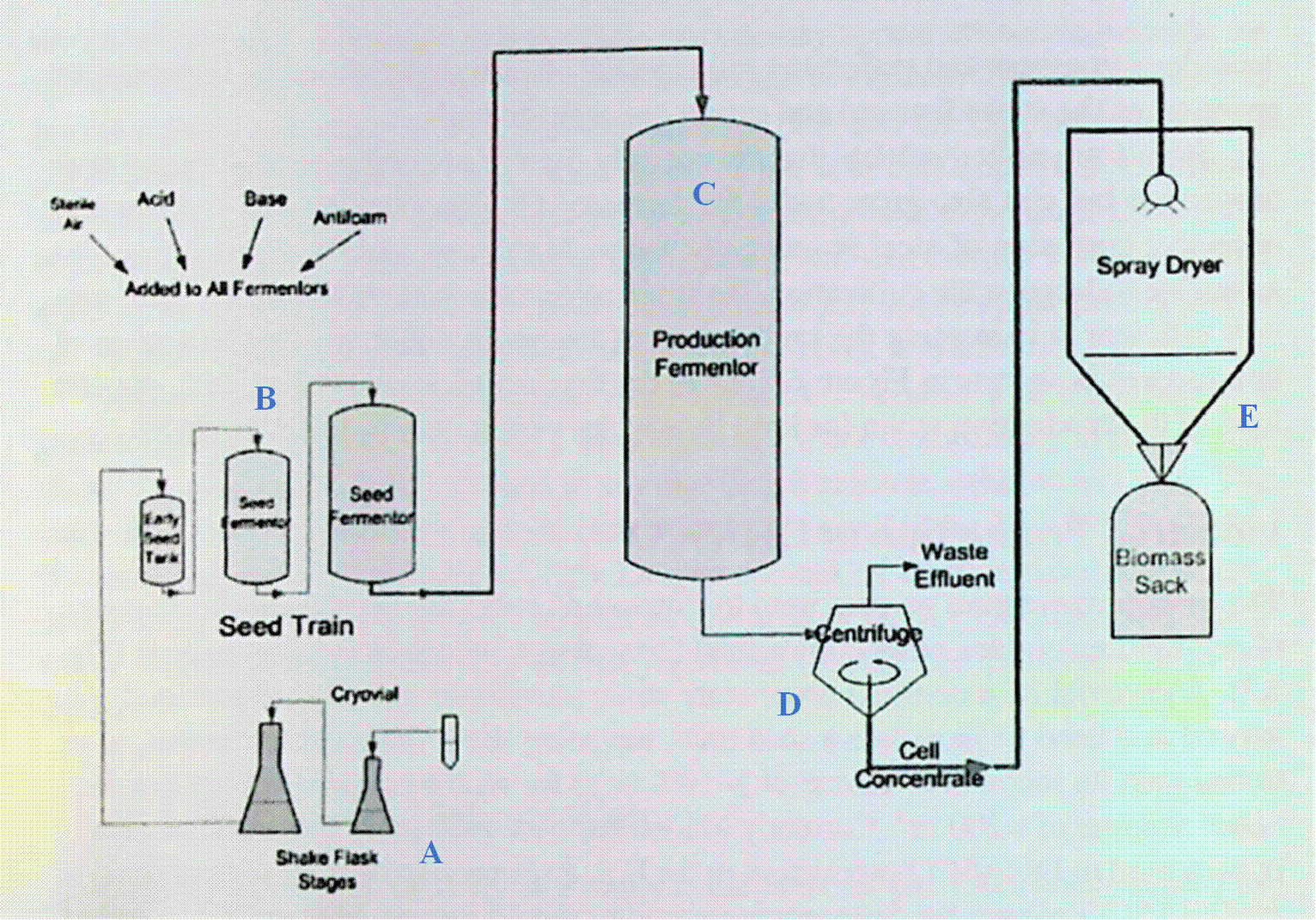
At first instance, Mellor J found EP155 valid (infringement having been admitted on that basis), EP740 invalid on several grounds, and EP801 invalid for obviousness — though he held it would have been partially infringed had it been valid. The appeals concerned EP155 and EP801 only.
Mara's appeal: obviousness of EP155 over Bijl
Mara contended that claim 1 of EP155 — covering a method of obtaining polyunsaturated fatty acid-containing lipid from Schizochytrium biomass using a protease — was obvious over a prior European patent application known as Bijl, published approximately three months before EP155's priority date.
The Court of Appeal declined to interfere. Lord Justice Arnold, giving the lead judgement, affirmed that the judge had committed no error of law or principle in any of his four reasons for rejecting Mara's obviousness case. Crucially, what was novel in Bijl was its proposal for solventless separation by centrifugation alone — yet Mara's case required the skilled team to discard that very teaching after finding it unworkable. What remained was, in substance, merely the common general knowledge concept of enzymatic lysis. The argument that a skilled reader of Bijl would reason from the violence of mechanical homogenisation toward the gentler emulsions produced by enzymatic methods was characterised as infected by hindsight, a conclusion supported by the absence of any unchallenged expert evidence that this thought process would arise spontaneously.
DSM's appeal: obviousness of EP801 over Kobzeff
DSM challenged the finding that EP801, as proposed to be amended (claim 1A), was obvious over Kobzeff — a related US patent application disclosing enzymatic liberation of lipids from biomass, including from Schizochytrium ATCC 20888.
DSM's primary ground concerned the construction of the integer "wherein the lipid contains less than 5% by weight of an organic solvent." DSM argued this imposed a process-wide restriction, requiring the lipid to contain less than 5% solvent at every stage. The Court disagreed, confirming the judge's construction: the phrase refers to the lipid as obtained at the conclusion of the process. As Lord Justice Arnold observed, the reference to "the lipid" tracks back through the claim to the lipid separated at step (d), and a process claim may perfectly properly be defined in part by its result.
On the contingent question of obviousness under DSM's preferred construction, the Court also upheld the judge's analysis. Kobzeff expressly contemplated direct separation without any polar organic solvent and identified salt and heat as potential demulsification tools. The judge was entitled to conclude from Mr Dueppen's cross-examination evidence that it would have been obvious to apply those techniques, with a sufficient expectation of success warranting at least routine laboratory investigation.
Both appeals were accordingly dismissed.
 Copyright & permissions